Ableton Live:
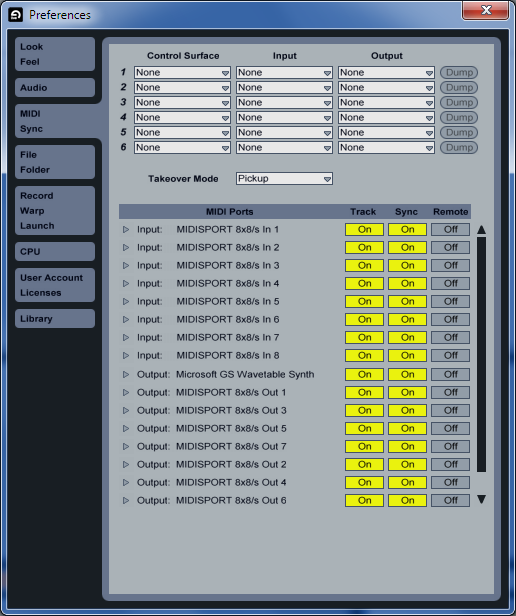
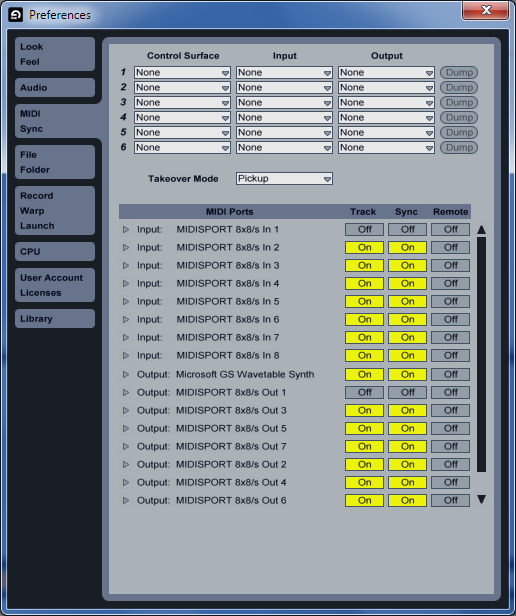
From “Options” menu select “Preferences” and click on the MIDI tab.
In the example below, we have our Evolver connected to MIDISPORT 8x8 ports 1 IN and OUT . We want to make sure that Ableton Live does not access those ports so we need to deactivate them.
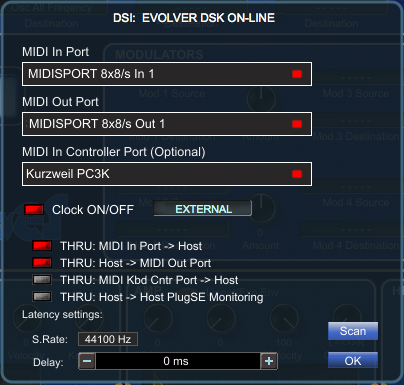
Start the Evolver PlugSE, the PlugSE will automatically search for the Evolver on all available ports. If everything is set up correctly, you should notice the “DSI EVOLVER ON LINE” message. If not, a warning message will inform you about incorrect Evolver Global settings.
NOT CONNECTED message informs you that the PluSE could not find the Evolver on any ports or the Evolver has not responded to MIDI requests.
In such case, check manually the Evolver global setting called: “MIDI SysEx: ON” just in case it was turned OFF. Please note, you may have to exit the Global settings mode for change to take effect.
Also, some other warnings may pop up like for example Parameter Send or Receive that are used to control the Evolver in real time.
.
In general, the Evolver Global settings that are relevant for the PlugSE operation should be set as follows:
|
●
|
MIDI Rec – determines what MIDI data to receive. Used to disable MIDI completely, or to filter out program changes or parameter changes.
|
Display MIDI Receive Operation:
-OFF No MIDI data received
-ALL All MIDI data received
-pro Only MIDI program changes received (along with note/controller data)
-par Only MIDI parameters received (along with note/controllerdata)
MIDI Rec should be set to ALL
|
●
|
MIDI Xmit – determines what MIDI data to send. If enabled Evolver will send out changes for all 128 Program Parameters in System.
|
Display MIDI Transmit Operation:
-OFF No MIDI data sent
-ALL All MIDI data sent
-pro Only MIDI program changes sent
-par Only MIDI parameters sent
MIDI Xmit should be set to ALL
To verify the MIDI SETUP, click on the MIDI button:.
Here you can manually set MIDI In and Out ports and configure other MIDI routings. The Scan button runs the same MIDI port scan as when the PlugSE was started.
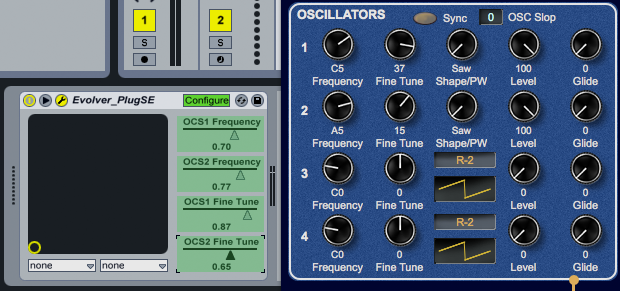
Now you can test VST automation by manually turning Evolver knobs that are assigned to some parameters or use PlugSE knob controls. All movements will be drawn on the automation track.
Let’s configure Evolver PlugSE parameters for playing. Click on Configure button: Move any control on the PlugSE screen and it will be added to Live’s list.
You are ready now to play, record, make custom envelopes etc.
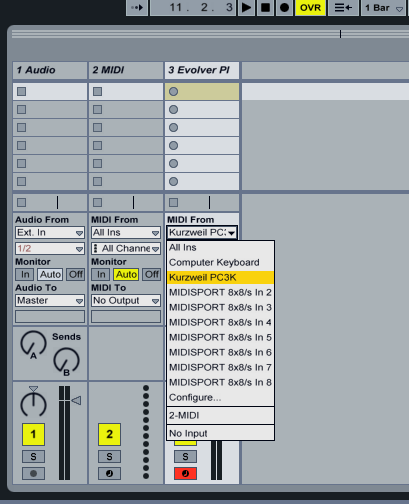
If you like tto play notes through the PlugSE using your external keyboard controller, you may have to make proper settings in Ableton Live to route MIDI signals to the PlugSE. In our setup we selected Kurzweil PC3K keyboard.
The PlugSE VST dll file should be placed in the VST plugins folder. Depending on
the VST host that folder could be located in various places on you hard drive. In
case of Steinberg’s Cubase this folder is located in the Cubase directory and it
is called “Vstplugins”. In Ableton Live the Vst folder can be selected and defined
in Preferences.
The PlugSE is designed to serve as a bridge between the host and the Evolver and
in principle the Evolver should be connected directly to the PlugSE via MIDI. By
default, most of the VST hosts are set to grab all MIDI ports on startup and this
may create a connection problem for PlugSE users.
Many MIDI interfaces are not multi-client - this means that ports can be opened and
used only by one application at a time. It also means that in practice, after you
start the host application the host may first access and open MIDI ports that your
Evolver is connected to and prevent the PlugSE from accessing the same ports later
on.
Even if your MIDI interface is multi-client and it is connected to the Evolver it
is still advisable to deactivate MIDI ports the Evolver is using in the host MIDI
setup in order to avoid double MIDI messages being send or received. The PlugSE will
handle all MIDI messaging and the connection between the Evolver MIDI and the host
is not needed.